
Where Are the Best Farming Regions in Nebraska? A Practical Guide for Buyers
Short Answer: The best farming region in Nebraska depends on what you plan to grow or raise. Eastern Nebraska leads the state for rainfed row crops like corn and soybeans. The Platte and Republican River valleys hold the strongest irrigated cropland. Southwest Nebraska and the Panhandle fit dryland wheat, sugarbeets, and dry edible beans at a lower cost per acre. The Sandhills remain the premier grazing land in the country.
Rainfall, soils, and water access change dramatically across Nebraska’s 450-mile width, and those differences shape crop options, input costs, and long-term farm income. At Lashley Land, our team works with farmers, ranchers, and investors in every one of these regions, and this guide breaks down where each type of farming operation fits best.
Nebraska Farming at a Glance
Nebraska holds about 44 million acres of land in farms and ranches, which covers more than 90 percent of the state, according to the Nebraska Department of Agriculture. Nebraska corn production reached 2.02 billion bushels in 2025, up 12 percent from the prior year, with an average yield of 194 bushels per acre across 10.5 million harvested acres, according to USDA figures reported by UNL CropWatch. Soybean production totaled 314 million bushels at 65.5 bushels per acre.
Nebraska ranks third in the nation for corn production, first in white corn, and first in corn fed to cattle. The state also leads the U.S. in irrigated cropland acres, thanks largely to the Ogallala Aquifer sitting beneath much of central and western Nebraska. On the livestock side, the state carried about 6 million head of cattle and calves at the start of 2025.
What Makes Nebraska Agriculture Different
A few features set Nebraska farming apart for buyers comparing states:
- Aquifer access. The Ogallala Aquifer supports more irrigated acres than any other state, giving producers yield stability that dryland regions elsewhere cannot match.
- A steep rainfall gradient. Annual precipitation runs above 30 inches in the southeast corner and drops below 16 inches in the Panhandle, so the same crop plan does not work statewide.
- Strong research support. Nebraska Extension and the Institute of Agriculture and Natural Resources at UNL publish on-farm research, land value surveys, and crop budgets that give buyers real data for management decisions.
- A working land ethic. Most ground in the state is held by family farm and family-owned farm operations, and much of it trades quietly through local relationships.
The Best Farming Regions in Nebraska, Broken Down
Eastern Nebraska: Rainfed Row Crop Country
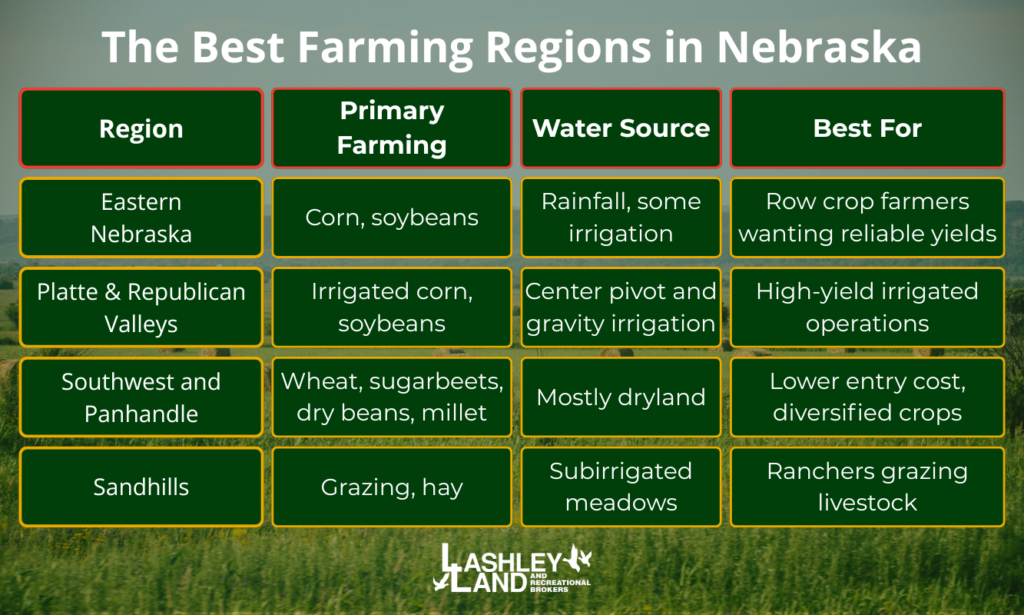
Eastern Nebraska is the state’s row crop heartland. Deep loess soils, 26 to 34 inches of annual rainfall, and consistent growing seasons produce some of the most dependable corn and soybean yields in the country.
That reliability comes at a price. Cropland values in the eastern regions run well above the statewide average, and competition from established family farms is heavy. Tracts near Omaha and Lincoln carry development pressure that adds appreciation potential for investors. If you want proven dryland yields, shorter hauls to markets, and land that holds value through commodity cycles, browse current listings on our Nebraska farms for sale page.
The Platte and Republican River Valleys: Irrigated Powerhouse
South-central Nebraska’s river valleys hold the state’s strongest irrigated ground. Center pivot systems fed by the aquifer produce corn yields that regularly top 220 bushels per acre on well-managed farms. Proximity to ethanol plants, feedlots, and rail means strong local demand and better cash prices for row crop farmers.
One caution for buyers: groundwater here is managed by Natural Resources Districts, and certified irrigated acres do not always transfer cleanly with the deed. Allocation rules vary by district, and a farm’s value depends heavily on its water status. Our water rights and mineral search service verifies exactly what a property carries before you commit.
Southwest Nebraska and the Panhandle: Dryland and Specialty Crops
Western Nebraska farming looks different, and for the right buyer, that is the appeal. Winter wheat, sugarbeets, dry edible beans, proso millet, and sunflowers anchor rotations built for limited moisture. Nebraska ranks among the top states for great northern and pinto bean production, most of it grown in the Panhandle.
The entry cost is the lowest in the state. Farmland in the Northwest region averaged just $970 per acre as of February 1, 2026. Drought conditions are a bigger management factor here than in the east, so crop insurance, fallow rotations, and moisture-saving tillage matter more. The region also supports newer niches, including producers licensed under Nebraska’s state hemp program and USDA licensing.
The Sandhills: Grazing Land, Not Cropland
Buyers sometimes ask about farming the Sandhills, but this region is mainly livestock country. The fragile, sandy soils erode easily when tilled, so the land is best left in grass, which is some of the best cattle range in America. Subirrigated meadows produce hay, and native grasses feed cattle most of the year without much supplemental feed.
Buyers have noticed. Non-tillable grazing land values rose 7 percent statewide in 2026 to an average of $1,315 per acre, driven by strong cattle prices. If your operation runs on grazing livestock rather than a planter, start with our Nebraska ranches for sale listings.
What Nebraska Farmland Costs Right Now
Nebraska’s statewide all-land average sits at $3,905 per acre as of February 1, 2026, down 1 percent and the second straight annual decline since the 2024 record of $4,015. The numbers vary by land type:
- Center pivot irrigated cropland averaged 2 percent lower statewide, with some regions down 4 to 8 percent.
- Gravity irrigated cropland declined 3 percent.
- Grazing land and hayland gained 4 to 7 percent on strong cattle markets.
- Cash rental rates for cropland fell 1 to 9 percent depending on land type and region.
Nebraska Extension agricultural economist Jim Jansen, who leads the survey, points to lower crop prices, higher input costs, and prevailing interest rates as the main pressures on cropland. For buyers, softening values create opportunities that did not exist two years ago, especially on irrigated ground in the regions with the steepest declines. Sellers of grazing land and hayland are in a strong market. Our investing in land and land loans resources cover how to evaluate returns and financing.
How to Choose the Right Region for Your Farm
Match the Land to What You Grow or Raise
Start with what you plan to grow or graze, then work backward to the region:
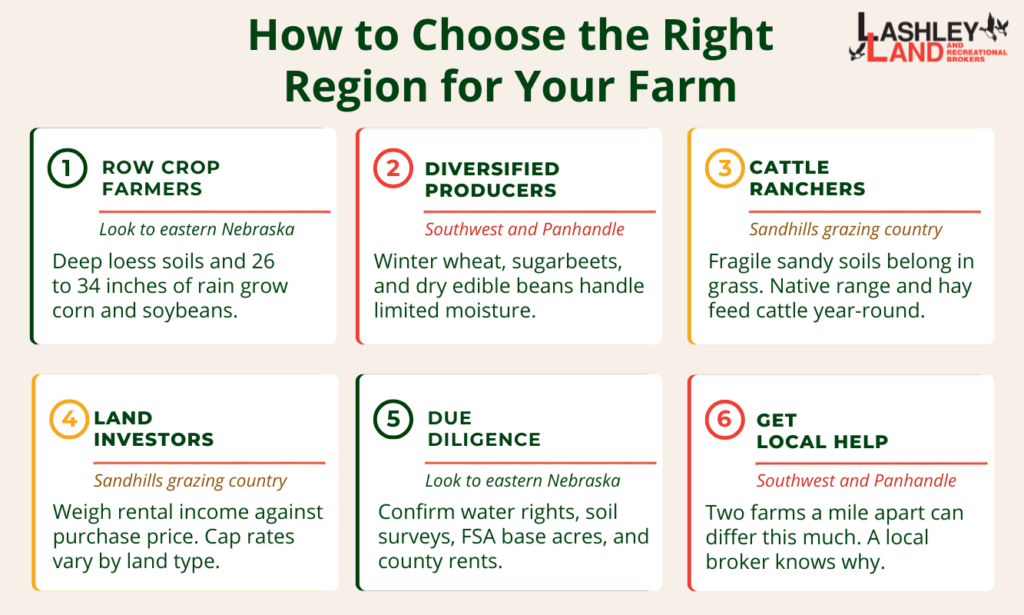
- Row crop farmers focused on corn and soybeans should look east or at irrigated valley ground.
- Diversified producers comfortable with wheat, beans, and rotations built around moisture belong in the southwest and Panhandle.
- Ranchers running cattle should focus on the Sandhills and western grazing country.
- Investors should compare rental rate income against purchase price by region, since cap rates vary widely between irrigated cropland and pasture.
Do Your Due Diligence Before You Buy
Regional averages hide county-level differences, so verify the specifics on every tract:
- Confirm water rights, well registrations, and NRD allocations in writing.
- Pull soil surveys and review on-farm research and crop budgets through Nebraska Extension.
- Visit the county FSA office to confirm base acres, program history, and eligibility for USDA programs available to agricultural producers.
- Review actual cash rents and recent comparable sales for the county, not just the region.
- Map your supply chain: distance to elevators, ethanol plants, feedlots, and rail affects your net price on every bushel.
Get Local Help
Two farms a mile apart can differ by $2,000 per acre based on soils, water, and improvements. A local broker will tell you which tract deserves the premium. Our farm and ranch management team can evaluate productivity upside after the purchase, our financing partners understand agricultural lending, and our land auctions offer another route to buy or sell.
Find Your Nebraska Farm with Lashley Land
The best farming region in Nebraska is the one that fits your crop mix, water needs, and budget. Eastern row crop ground, irrigated valley farms, western dryland tracts, and Sandhills range each reward buyers who understand the local market.
Lashley Land & Recreational Brokers brings more than 140 years of combined experience across every region of the state. Contact us today to talk with a Nebraska land specialist about your farming operation, or start browsing Nebraska farms for sale now.