
How to Invest in Farmland (And Why It’s One of the Smartest Moves You Can Make)
Short answer: Define your goals, understand what makes land valuable, secure financing, and work with a broker who knows the market. Whether you’re buying physical acres or exploring farmland REITs and crowdfunding platforms, the process is straightforward, but the details matter.
Farmland is one of the most reliable long-term investments out there. It produces income, appreciates over time, and isn’t going anywhere, while the stock market swings and real estate markets cool off.
Here’s how to get started.
Why Farmland Is Worth Your Attention
A Track Record That Speaks for Itself
The NCREIF Farmland Index has tracked U.S. farmland performance for decades, and the numbers are hard to argue with. Farmland has consistently rivaled, and often beaten, the broader stock market with far less volatility.
The appeal comes down to dual income streams:
- Rental income from cash rent or crop-share agreements
- Farmland value appreciation over time
Strong commodity prices and growing demand for crop production have only strengthened those returns in recent years. Past performance doesn’t guarantee future results, but farmland’s track record as a stable asset class is hard to ignore.
It’s a Tangible Asset You Can Actually Walk On
Unlike a mutual fund, exchange traded fund, or real estate investment trust, farmland is something you can see and touch. It doesn’t depreciate to zero. It doesn’t file for bankruptcy.
For families in rural communities, it carries emotional weight too. Land passed down through future generations isn’t just an investment. It’s a legacy.
Nebraska’s Position in the Farmland Market
Nebraska consistently ranks among the top agricultural states in the United States, thanks to:
- Diverse crop production — corn, soybeans, wheat
- A strong cattle industry
- Extensive irrigation infrastructure
For farmland investors, Nebraska also offers value. Land prices remain more accessible than Iowa or Illinois, which means better entry points and stronger potential returns for your investment portfolio.
Know What You’re Buying: Types of Farmland Investments
Not all farmland investments look the same. Here’s what’s out there.
Tillable Cropland
The most straightforward farmland investment:
- Buy productive acres, lease them to a farmer, collect rental income
- Soil quality is the single biggest factor in value and return
- A few points difference in productivity rating can mean thousands of dollars per acre
- Tillable cropland is the backbone of the agriculture sector, and demand stays strong across the U.S.
Irrigated vs. Dryland
In Nebraska, this distinction matters more than almost anywhere:
- Irrigated land: higher price, but more consistent crop yields even in dry years
- Dryland: more affordable, but production depends entirely on rainfall
- Water rights and well permits are critical. Nebraska’s regulations vary by Natural Resources District, so understand them before you buy.
Pasture and Ranchland
- Lower price per acre than tillable ground
- Returns come through grazing leases
- Often carries recreational value — hunting, fishing, general outdoor use
- Nebraska’s Sandhills and river corridors offer particularly strong options
Combination and Recreational Properties
Some of the most interesting listings blend tillable acres, pasture, timber, and recreational ground into one purchase. These appeal to investors who want:
- Financial returns and personal enjoyment from the same property
- An alternative investment that goes beyond a brokerage account
- A mix of income sources from a single piece of agricultural land
How to Evaluate a Farmland Investment
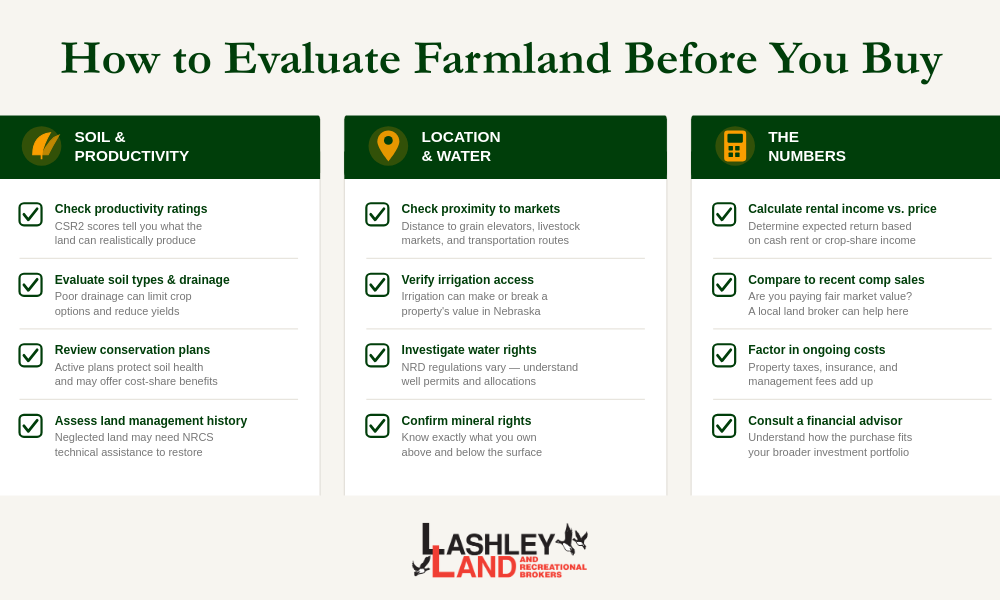
Buying farmland isn’t like buying a house. Here’s what actually drives value.
Start With the Dirt: Soil Quality and Productivity
Soil health is the foundation of any farmland purchase:
- Productivity ratings (like CSR2 scores) tell you what the land can realistically produce
- Higher ratings = higher rent potential and higher resale value
- Look at soil types, drainage, and existing conservation plans
- Land that’s been neglected may offer upside but could require technical assistance from agencies like NRCS to restore
Location, Access, and Water
Just like any real estate investment, location matters:
- Proximity to grain elevators, livestock markets, and transportation routes
- Water access: irrigation can make or break a property’s value in Nebraska
- Mineral rights and water rights: always investigate before closing. Know what you own above and below the surface.
Understanding the Numbers
Before making an offer:
- Calculate potential rental income against the purchase price
- Compare asking price to recent comparable sales
- Factor in property taxes, insurance, and management costs
- Work with a financial advisor to understand how the investment fits your broader portfolio
- Don’t overlook a local land broker’s insight on pricing trends
Ways to Invest in Farmland
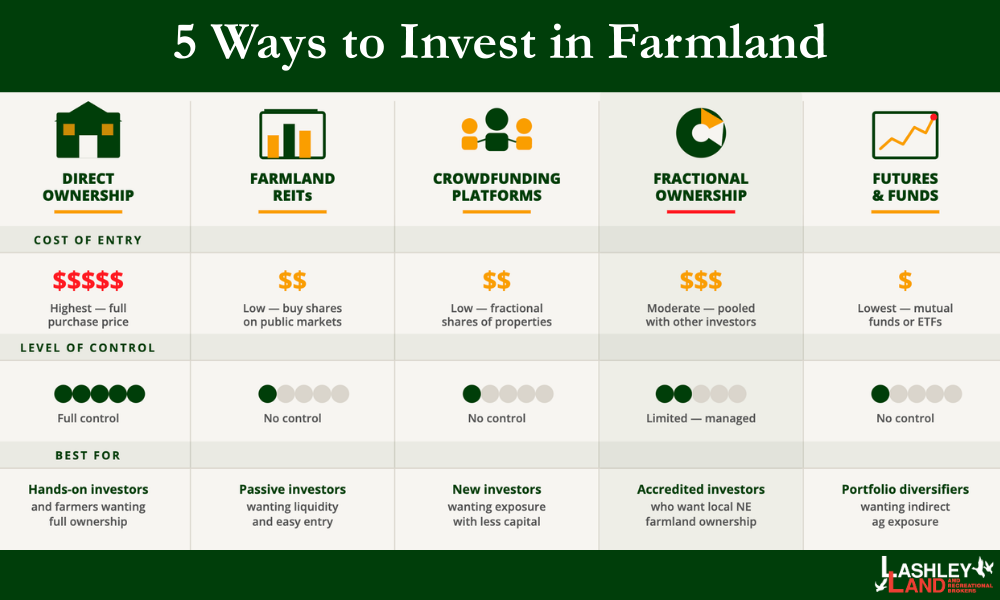
Buying physical land isn’t the only path into the farming sector. Here are the main investment vehicles.
Direct Ownership
The most traditional, and for most farmland investors, the most rewarding approach:
- Purchase a farm, lease it to an operator, collect rental income
- Full control over long-term leases, conservation plans, and recreational development
- Best for investors who want a hands-on role or personal connection to the land
Farmland REITs
Farmland REITs (real estate investment trusts) pool investor capital to buy and manage agricultural land across the U.S.:
- Publicly traded, so they offer liquidity and low barriers to entry
- You don’t control the land or management decisions
- Returns are tied to the REIT operator’s strategy
- A good option for individual investors who want exposure without owning physical acres
Crowdfunding Platforms
Several crowdfunding platform options have emerged in recent years:
- Companies like Iroquois Valley let you buy fractional shares of specific properties
- Often focused on sustainable agriculture and soil health
- Good entry point for newer investors, but understand the fees and lock-up periods
- Always confirm you’re working with a registered broker-dealer or properly structured vehicle
Other paths exist — futures contracts, private equity funds, mutual funds — but they’re indirect plays on the agriculture sector rather than true farmland investing. For most individual investors, direct ownership, REITs, or crowdfunding platforms are the most accessible starting points.
Lashley Land’s Fractional Farm Ownership Program
Most farmland investment options fall into two camps — buy the whole farm yourself, or invest passively through a REIT or crowdfunding platform where you never set foot on the land. Lashley Land’s Fractional Farm Ownership Program sits right in the middle.
The concept is simple: multiple accredited buyers pool capital through an LLC to purchase qualified Nebraska farmland. The original farmer stays on as a tenant with a long-term lease, and buyers earn rental income plus potential appreciation, all under professional farm management.
It’s an ownership vehicle built to keep Nebraska land in Nebraska hands, connecting local buyers with local farmers who need capital without walking away from the ground they know.
The program serves two audiences:
- Buyers who want to own real Nebraska farmland without buying the whole farm — lower cost of entry, shared risk, passive role, and all the financial benefits of real estate ownership
- Landowners who need to unlock equity and strengthen their balance sheet while continuing to farm through a confidential, all-cash transaction with a leaseback option
To qualify as a buyer, you must be an SEC-accredited buyer.
Want the full details? Learn more about our Fractional Farm Ownership Program or call our office at 308-532-9300.
Financing Your Farmland Purchase
Ag Lenders and Farm Credit Institutions
Agricultural lenders — Farm Credit Services, local ag banks, FSA loan programs — are built for this. They understand the land market in ways conventional mortgage lenders don’t.
What Lenders Look For
- Down payment of 20–35%, depending on the lender and property
- Proof of income or a clear plan for how the land generates returns
- Appraisals, soil reports, and water rights documentation
Cash vs. Financed
- Cash simplifies the deal and strengthens your offer
- Financing lets you leverage capital for improvements or additional purchases
- The right answer depends on your situation, goals, and how the land fits your investment portfolio
Lashley Land can connect you with trusted ag lenders familiar with Nebraska land transactions.
Working With the Right Team
Why a Land-Specialized Broker Matters
Farmland is a unique corner of real estate, and general agents often lack the knowledge to navigate it. A land broker brings:
- Understanding of soil productivity, water rights, and ag lease structures
- Local comparable sales data and pricing trends
- Negotiation experience specific to farm and ranch transactions
- Insight into how commodity prices and the agriculture sector affect land values
In Nebraska, local expertise matters even more. Values and regulations shift from one part of the state to another.
Other Professionals You’ll Want
- Ag attorney — for contract review and title work
- Tax advisor — for 1031 exchanges, depreciation, and ag tax benefits
Farm manager — especially if you’re an absentee owner or new to agriculture
Farmland Is a Long Game Worth Playing
Farmland investing rewards those who do their homework: on the soil, the market, and the people they work with. Whether you’re buying your first quarter section or exploring farmland REITs and crowdfunding platforms, the key is understanding what you’re investing in and why.
Nebraska offers some of the best farmland value in the United States — strong productivity, diverse agriculture, and room for appreciation. It’s a proven asset class that has delivered for generations.
Lashley Land brings over 140 years of combined experience in Nebraska land sales. We’re here to walk you through every step.Contact Lashley Land today to talk through your goals and see what’s available.