
How to Buy Land and Build a House: A Homeowner’s Guide
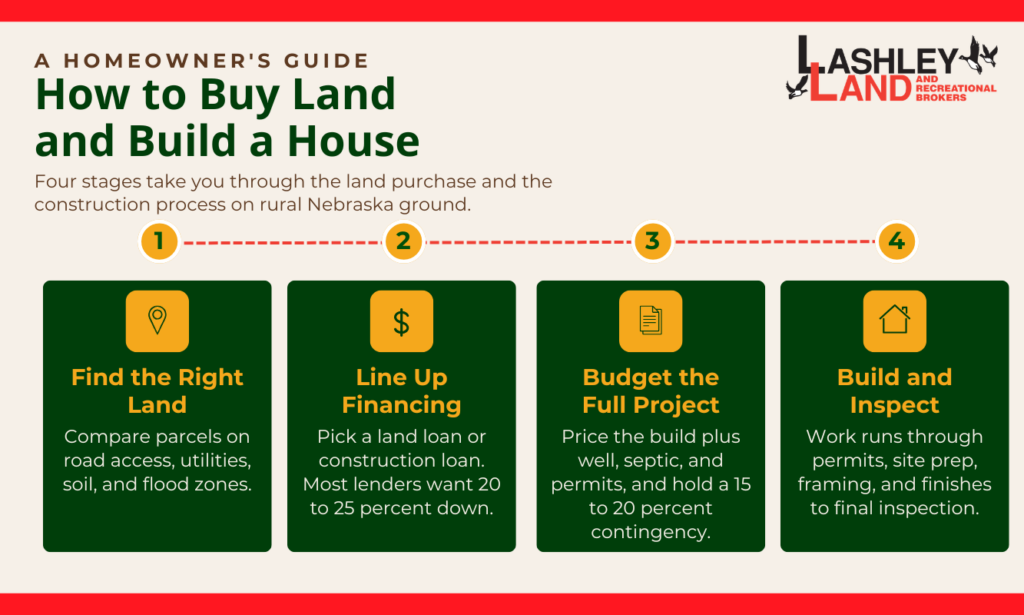
Short Answer: Buying land and building a house follows four stages. First, find a plot of land that fits your building plans and complete due diligence on utility access, soil quality, and zoning. Next, secure financing through a land loan or construction loan. From there, your builder can handle permits, site preparation, and construction. Most custom home projects take 10 to 16 months and cost $150 to $300 per square foot before the land purchase, though Midwest builds often land near the lower end of that range.
Buying land and building a custom home gives you control that no existing house can match, but it involves more moving parts than a standard purchase. The buyers who do well plan the land purchase, the financing, and the construction as one connected project. This guide walks through each stage, with numbers you can use to build a realistic budget for rural Nebraska.
Step 1: Find the Right Plot of Land
The land you choose sets the cost and difficulty of everything that follows. A level parcel with road access and nearby utilities can save you tens of thousands of dollars compared to raw land that needs a driveway, a well, and a long power run.
Start by deciding how you want to live, then match the property to it. A 3-acre acreage twenty minutes outside North Platte is a very different project than 80 acres of undeveloped land in the Sandhills.
What to Look for in Potential Properties
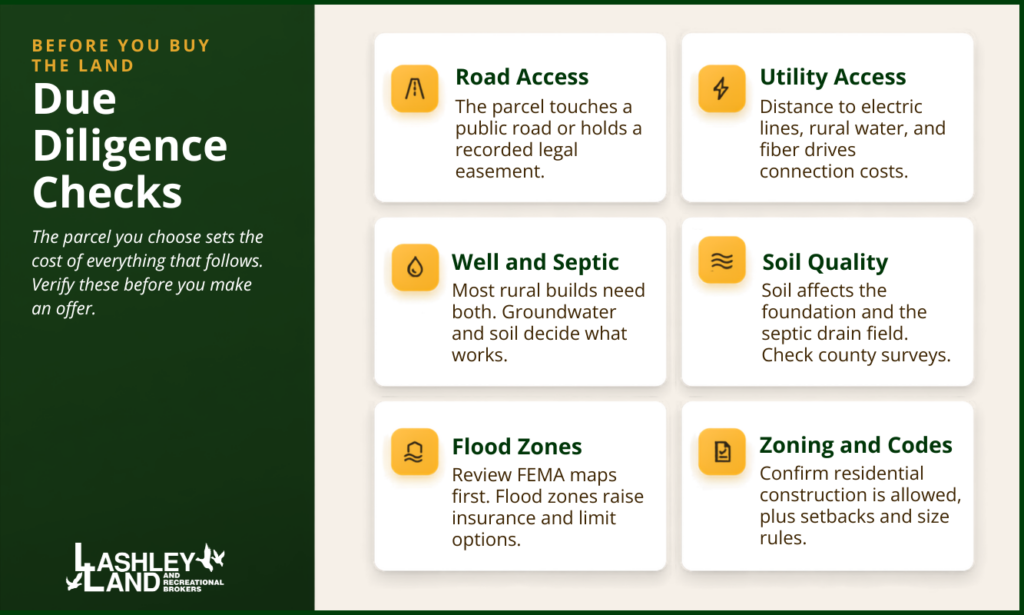
As you compare potential properties, weigh these factors before you fall in love with a view:
- Road access: Confirm the parcel touches a public road or has a recorded legal easement.
- Utility access: Check the distance to electric lines, rural water districts, and fiber. Internet access matters more than most buyers expect.
- Water and septic: Most rural Nebraska builds need a private well and a septic system. Both depend on groundwater conditions and soil.
- Soil quality: Soil affects your foundation, your septic drain field, and any pasture or garden plans. County soil surveys are free through the USDA Web Soil Survey.
- Flood zones: Check FEMA flood maps before you make an offer. Building in a flood zone raises insurance costs and limits your options.
- Zoning and building codes: Verify with the county that residential construction is allowed and learn the setback and minimum-size rules that apply.
- Drive times: Map the distance to work, schools, grocery stores, and a hospital. Country living works best when the drive still fits your life.
What Land Costs in Nebraska Right Now
Agricultural land in Nebraska averaged $3,905 per acre as of February 1, 2026, according to the University of Nebraska-Lincoln’s 2026 Farm Real Estate Market Survey. That statewide average covers everything, including cropland well above it and western grazing land well below it. Small acreages near towns are priced per parcel rather than per acre and usually carry a premium for road frontage and utilities.
Two years of slightly softer values have given buyers more negotiating room. Our guide to evaluating Nebraska farmland per acre breaks down how land class and region change the math, and you can browse current Nebraska land for sale and acreages to see real asking prices. A real estate agent who works in land transactions every week will also spot problems a residential-only agent can miss, such as access disputes or water rights questions.
Step 2: Line Up Your Financing
Financing a build works differently than buying an existing home, because lenders treat vacant land and unfinished houses as riskier collateral than a completed home. Expect larger down payments and slightly higher rates, and expect the lender to review your builder and construction plans before approving anything.
Land Loans vs. Construction Loans
You have three main financing options, and the right one depends on your timeline:
- Land loan: Finances the land purchase only. Down payments typically run 20 to 35 percent depending on the parcel, and this route makes sense if you plan to buy now and build in a few years. Our land loans page covers how these work in detail.
- Construction loan: A short-term loan, usually 12 to 18 months, that pays your builder in draws as work is completed. You make interest-only payments on the amount drawn during construction, then pay the balance off with permanent financing.
- Construction-to-permanent loan: Combines both steps. The loan funds construction, then converts to a traditional mortgage when the home is finished, with one closing and one set of fees.
Construction loan rates generally run 1 to 2 percentage points above standard mortgage rates. With the 30-year fixed averaging 6.58 percent in late July 2026, that puts many construction loans in the 7.5 to 8.5 percent range. Most lenders want 20 to 25 percent down on the total project cost and a credit score of 680 or better for competitive terms.
Rural Financing Options Worth Checking
USDA’s Single-Family Housing Guaranteed Loan allows zero down payment for qualified buyers in eligible rural areas, and some lenders offer it as a construction-to-permanent product. Most of Nebraska outside Omaha and Lincoln qualifies on the location test, though income limits apply and not every lender offers the program.
Local and regional banks that know agricultural lending are often the best fit for rural builds, since they understand well and septic costs, long utility runs, and acreage appraisals. Lashley Land maintains relationships with lenders who work in rural property every day, and our financing page explains the options and connects you with them. When you calculate your monthly payment, run the numbers on the full project cost, not just the land: a $70,000 parcel with a $350,000 build behaves like a $420,000 mortgage once the loan converts.
Step 3: Budget the Real Construction Costs
National residential construction data puts standard builds at $150 to $300 per square foot, with Midwest projects often falling between $100 and $150 per square foot for straightforward plans. Average construction costs near $323,000 for a 2,000-square-foot home before land.
Additional Costs Beyond the Build
Rural sites add line items that a subdivision lot doesn’t have. Budget for these before you sign a construction contract:
- Site preparation: Clearing, grading, and a driveway can run $5,000 to $50,000 or more depending on terrain and driveway length.
- Well and septic system: Plan on $10,000 to $30,000 combined in most of Nebraska, more where the water table sits deep.
- Utility connections: Power line extensions often cost $10 to $30 per foot past the first span the utility covers. A half-mile run adds up fast.
- Permits and fees: Building permits, septic permits, and inspections typically total $1,200 to $10,000 depending on the county.
- Land survey: A boundary survey runs roughly $500 to $2,500.
- Architectural plans: Stock floor plans cost $500 to $5,000. Full custom architectural plans can run $10,000 to $50,000.
- Contingency: Set aside 15 to 20 percent of the construction budget for overruns and change orders.
Property taxes also change once your new construction is assessed as an improved residential parcel, so ask the county assessor for an estimate early. For a fuller breakdown of Nebraska-specific numbers, see our guide to the cost to develop land in Nebraska.
Step 4: Manage the Construction Process
Once financing closes, the construction process follows a fairly predictable order. Your builder finalizes construction plans and pulls the necessary permits, then work moves through site preparation, foundation, framing, mechanical rough-ins, insulation and drywall, finishes, and final inspection. Production-style homes take 7 to 9 months. Custom home construction usually takes 12 to 18 months once you count design and permitting time.
How to Keep Your Build on Track
A few habits separate smooth builds from painful ones:
- Finalize the floor plan before breaking ground. Mid-construction changes are the most expensive decisions you can make.
- Get three builder bids on identical plans.
- Put allowances in writing. Know exactly what the contract includes for flooring, cabinets, and fixtures, and what counts as an upgrade.
- Visit the site weekly. A misplaced window caught at framing is a cheap fix, while the same mistake found after drywall means tearing out finished work.
- Keep your lender’s draw schedule in mind. Builders get paid as stages are inspected and approved, which protects you if problems come up.
Build Your Nebraska Home on the Right Ground
Careful planning at the land stage prevents most of the expensive surprises people associate with building. Verify access, water, and utilities before you buy, finance the land and the build as one project, and hold a 15 to 20 percent contingency so a surprise doesn’t stall the job.
Lashley Land has helped Nebraska buyers find building sites across the state for decades, with over 140 years of combined experience in land, water rights, and rural homes. If you’re ready to find the right parcel for your new home, contact us to talk with a Nebraska land specialist about where and how to start.