
What Does Farm Land Cost in Nebraska in 2026?
Short answer: Nebraska farmland averaged $3,905 an acre in early 2026, down about 1% from the year before, but that average buries a wide range. Center pivot irrigated ground runs near $8,500 an acre, while open grazing land sits closer to $1,300 to $1,900. What a specific tract costs comes down to its soil, its location, and whether it has water.
Farmland costs vary in nearly every county. Price depends on the dirt, water, and what the ground can grow, and all three change from one part of the state to the next. The past two years have pulled the market in two directions at once, with cropland easing off its highs while pasture and hay keep climbing. Knowing where the numbers sit puts you in a better spot to price a listing or size up an offer.
Nebraska Land Values by Class of Ground in 2026
Nebraska land has eased off its high, with the statewide average peaking at $4,015 an acre in 2024 before slipping in each of the two years since. The current averages reflect what appraisers, farm managers, and ag bankers across the state are seeing on real deals, not asking prices.
The statewide average is a starting point, not a price tag. Agricultural land values swing hard depending on the class of ground:
- Center pivot irrigated cropland tops the list at about $8,515 an acre.
- Gravity irrigated cropland runs around $7,510 an acre.
- Dryland cropland with irrigation potential averages roughly $6,070 an acre. Without that potential, non-irrigated cropland averages about $4,395.
- Hayland sits near $2,525 an acre.
- Tillable grazing land averages about $1,890 an acre, and nontillable grazing land about $1,315.
Location stretches those numbers further stillLocation stretches those numbers further still. Irrigated ground in eastern Nebraska can bring many times what dryland out in the Northwest sells for. Same state, wildly different land prices, and that gap is nothing new here.
The Irrigation Premium
Water is what separates good ground from great ground in Nebraska. Irrigated cropland routinely sells for a few thousand dollars an acre more than comparable dryland, because a reliable well off the Ogallala Aquifer turns a gamble on rain into a dependable yield. A permitted well and a working pivot can move a price more than soil color does. Before you buy, confirm the water rights and talk to the local Natural Resources District, which controls groundwater allocations across the state. Lashley Land runs water rights and mineral searches that show exactly what a parcel’s water is worth before you commit.
Why Cropland and Grazing Land Are Moving in Opposite Directions
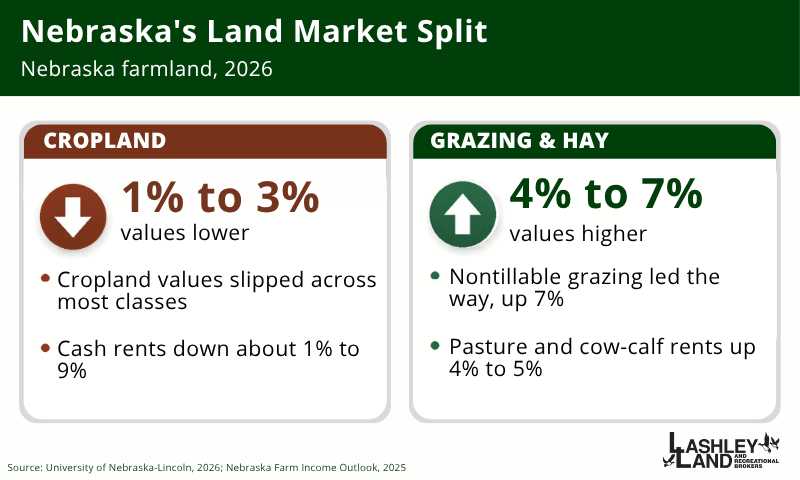
The 2026 market is splitting in two. Cropland is cooling while grazing land heats up. Grazing land and hayland climbed 4% to 7% over the past year, led by a 7% jump in nontillable grazing land. Most irrigated and dryland cropland classes went the other way, down 1% to 3%.
It comes down to what pays. Lower commodity prices for corn, soybeans, and wheat cut Nebraska crop receipts by about $577 million, or 16%, in 2025. Over the same stretch, livestock receipts jumped $3.22 billion on the back of strong cattle prices. When cattle print money, and grain barely breaks even, buyers chase grass and back off cropland.
Cattle Prices are Lifting Pasture Costs
The beef market has put a solid floor under grazing land. Cash rents for pasture and cow-calf pairs climbed about 4% to 5% across the state in 2026. Producers building their herds need somewhere to run cattle, and they are paying for it. Producers building their herds need somewhere to run cattle, and they are paying for it. That demand is why nontillable ground with almost no crop value still posted the biggest gain of any class this year.
The national picture cuts the other way. Cropland values across the country kept climbing to fresh records in 2026, and Iowa still leads the Corn Belt. Nebraska’s crop-heavy ground drifted down even as national farmland values rose, because thin grain margins hit this state harder than the country as a whole.
What Drives Farmland Cost
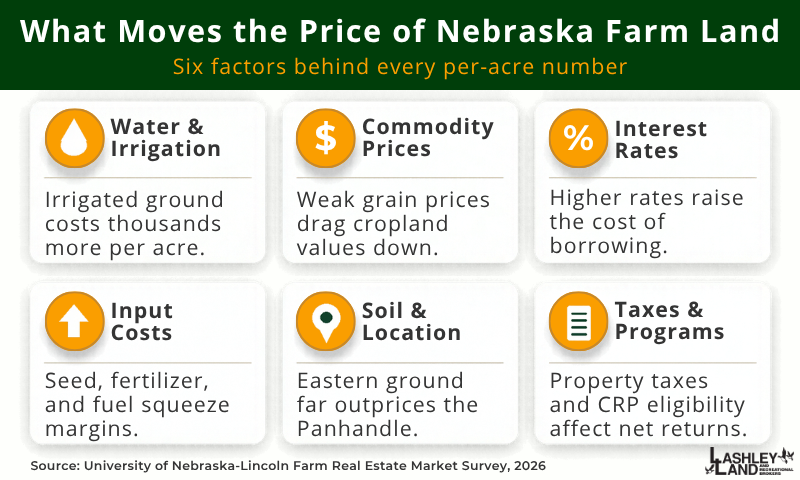
A handful of forces set the price on any given tract, and together they shape agricultural real estate values statewide. Once you understand them, you can tell a fair asking price from a hopeful one.
- Commodity prices and farm income steer cropland demand. Weaker grain prices in 2025 and 2026 squeezed margins and pushed downward pressure onto farmland prices.
- Interest rates decide what borrowing costs. Rates are still running above their 10-year average, which makes financed purchases pricier and cools the land market.
- Input and production costs for seed, fertilizer, and chemicals stay high against what crops bring, thinning cash flow and capping what agricultural producers can pay per acre.
- Water and irrigation carry a heavy premium, and access to the Ogallala Aquifer is often the line between a top-dollar tract and an average one.
- Soil, location, and district set the floor, which is why eastern Nebraska commands several times what Panhandle ground brings.
- Property taxes and program eligibility, including the Conservation Reserve Program and other conservation practices, shape net returns and resale value.
Rural appraisers weigh all of this against recent comparable land sales to land on a defensible number. No statewide average beats a boots-on-the-ground look at the actual parcel. That is where a broker earns their keep. Lashley Land weighs those same factors against recent comparable sales to give you a grounded read on a specific tract.
What Farmland Rents For: Cash Rent in 2026
Rent is the other half of the value equation, because it tells you what an acre earns each year. Rental rates often move before sale prices do, so they hint at where the market is headed. Cropland rental rates softened in 2026, down about 1% to 9% across dryland and irrigated ground, while pasture and cow-calf rates pushed higher on that same cattle strength.
Here is roughly what the ground rented for in 2026:
- The average cash rent for dryland cropland ran about $220 an acre in the East District and closer to $34 in the Northwest.
- Center pivot irrigated cropland averaged around $335 an acre in the East District.
- Pasture rents landed between about $17 and $79 an acre, depending on district and quality.
- Cow-calf pair monthly rates climbed 3% to 8% as grazing demand held up.
Drought conditions are on plenty of minds for 2026 leases. Many landowners now build in early-removal clauses that let them pull cattle if the grass runs short, which is worth asking about on any pasture lease.
Using Cash Rent to Check Value
Plenty of buyers work backward from rent to sanity-check a price. If an irrigated acre costs $8,500 and rents for $335, the gross rent-to-value ratio comes out around 4%. Run that same math on a few tracts, and you can see which one is priced closest to what it actually earns. Rent will not replace a real appraisal, but it keeps the conversation honest. If you would rather not chase tenants and payments yourself, Lashley Land’s farm and ranch management team handles leases and rent collection to keep your ground earning.
Buying or Selling: How to Price Nebraska Land Right
Averages tell you the neighborhood, not the address. Every tract sells on its own merits, and a local appraisal plus fresh comps will always beat a statewide number.
- Buyers have room to work while cropland softens, especially on irrigated tracts where only a handful of operators are bidding. Check the water rights, the irrigation equipment, and the soil ratings before you make an offer. Beginning farmers and seasoned operators alike are finding openings this year.
- Sellers holding pasture, hayland, or cattle-ready ground are meeting real demand in 2026 and can often price at or above the district average. Listing with Lashley Land puts your ground in front of buyers statewide through national syndication and land auctions.
- Both sides win by looking at what recently changed hands. Recent farmland sales in your county show the real sale price buyers are paying, which the averages only hint at.
A broker who works Nebraska ground every day can price a tract to its class, its district, and its water instead of a blanket average. A dedicated farm and ranch management team helps owners get more out of the land too, which protects long-term value.
The Bottom Line on Nebraska Farm Land Cost
Nebraska farmland runs about $3,905 an acre on average in 2026, but that number changes once you factor in irrigation, grass, and location. Cropland has come off its peak as grain margins tightened, while pasture and hay keep gaining on strong cattle prices. Water, soil, and district still decide what any single acre is worth, and no headline average will price your ground for you.
With more than 140 years of combined experience, Lashley Land helps Nebraska farmers, ranchers, and investors buy and sell with straight, local advice. Take a look at current Nebraska farms for sale, or contact us to set up a free property consultation and get a real answer on what your ground is worth.