

A Complete Guide to Hunting Public Land in Nebraska
Short Answer: Nebraska gives hunters more than 1.2 million acres of publicly accessible land, from the Pine Ridge in the northwest to the Missouri River bluffs in the east. The ground holds whitetail and mule deer, upland birds like pheasant and bobwhite quail, turkey, and waterfowl. Most of that access is state Wildlife Management Areas, federal land, and private acres opened through the walk-in program. Getting out there takes a valid permit and, for hunters in the required age range, hunter education. From there, the Nebraska Public Access Atlas is a handy way to find open ground near you.
Nebraska hunting rewards people who plan ahead. The state’s public land is spread across regions with different terrain and different game, so where you go depends on what you want to hunt. Unlike more crowded destinations, Nebraska’s public ground still offers real solitude, wide country, and space between hunters. This guide covers where to find public hunting land in Nebraska, the permits and rules you need, what species you can pursue through the year, and how to buy a piece of your own.
Where to Find Public Hunting Land in Nebraska
Public hunting land in Nebraska is easier to find than a lot of hunters expect, and the Nebraska Game and Parks Commission keeps most of it organized in one place. It helps to know the main categories, since each one comes with its own access rules and its own kind of ground.
Public hunting land in Nebraska falls into a few main categories:
- Wildlife Management Areas (WMAs): State-owned tracts managed for wildlife habitat and public hunting. Nebraska has more than 450 WMAs spread across the state.
- Open Fields and Waters (OFW): A walk-in program that pays private landowners to allow public hunting, trapping, and fishing. As of the 2025-26 season, more than 900 landowners had enrolled over 471,000 acres of private ground.
- Federal land: Includes the Nebraska National Forest, national grasslands, and Waterfowl Production Areas managed by the U.S. Fish and Wildlife Service.
- State parks and recreation areas: Some allow hunting in designated zones and seasons.
Most of this land runs on a first-come, first-served basis, with no reservation and no draw for the ground itself. The Nebraska Public Access Atlas is the tool that ties it all together. The digital version updates throughout the year and lets you scout boundaries, parking, and aerial imagery before you leave home. The mobile-friendly map works offline, which matters in the parts of the state with weak cell service. Park only in designated areas, watch for posted signage, and respect the fence lines between public access and private property.
Permits, Regulations, and Hunter Education
Before you hunt public land in Nebraska, you need the right permit and, for many hunters, proof of hunter education. Residents start with a basic hunting permit. Non-residents buy a non-resident permit, which costs more and sometimes runs on a unit-specific tag for big game. Species like deer, turkey, and antelope require their own tags, and waterfowl hunters need state and federal stamps.
Here is what to line up before the season:
- Hunting permit: Required for all hunters. Big game tags are often unit-specific, so check the unit and its season before you buy.
- Hunter education: The Nebraska Game and Parks Commission requires it for all hunters age 12 through 29 who hunt with a firearm or use a bow for big game. Classroom, hybrid, and online courses are available.
- Habitat stamp and species stamps: Most permits require a habitat stamp. Duck and goose hunters also need state and federal migratory bird stamps.
- Apprentice option: New hunters age 12 through 29 can buy a $5 Apprentice Hunter Education Exemption Certificate and hunt under a qualified mentor before finishing the full course.
Legal hunting hours generally run from 30 minutes before sunrise to 30 minutes after sunset, though this shifts by species. Bag limits, season dates, and zone rules change from year to year, so read the current regulations from the parks commission before every season. Many public areas keep 100-yard safety zones around parking lots and buildings where hunting is off limits.
Nebraska also puts real weight behind youth hunting. Hunters under 16 get youth seasons for deer, turkey, and small game, often ahead of the regular openers, with a licensed adult along. It is one of the better ways in the region to bring a new hunter into the sport.
What You Can Hunt and When
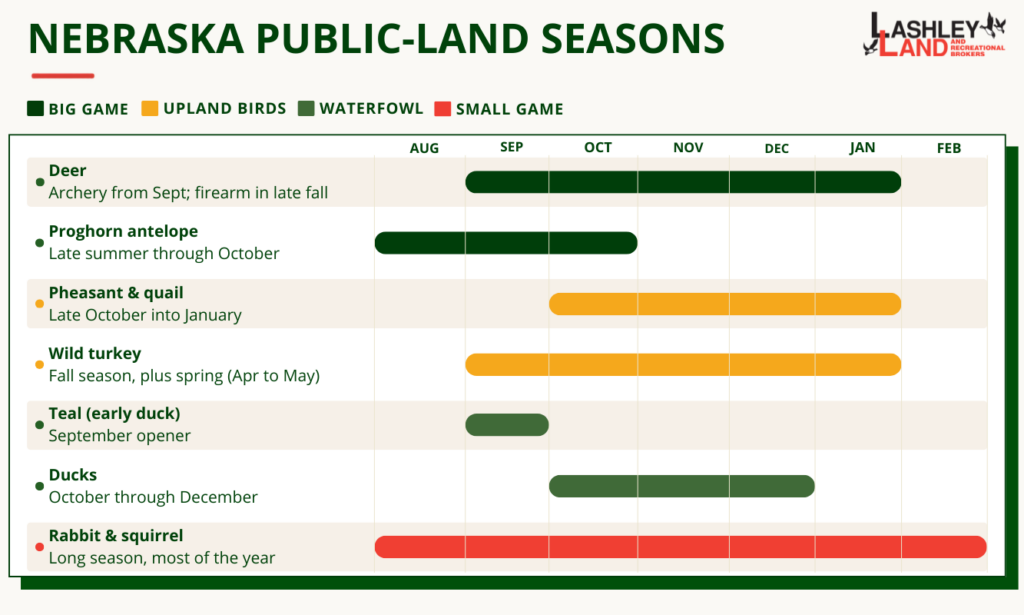
Nebraska’s habitat runs from shortgrass prairie to river-bottom timber, and the game follows the ground. The state supports strong populations of big game, upland birds, waterfowl, and small game across its public areas.
Big Game
Deer hunting anchors Nebraska’s fall seasons. Whitetail deer range statewide, with archery season opening in September and rifle season running into the colder months. Mule deer are the main draw in western Nebraska, especially the Pine Ridge and the Sandhills, where open country and broken terrain hold good numbers and the occasional mature buck. Pronghorn antelope hunting runs from late summer through October, mostly in the Panhandle, where the terrain suits these fast prairie animals.
Upland Birds
Nebraska’s grasslands and crop edges make it strong upland bird country. Ring-necked pheasant season runs from late October into January, with strong public hunting around McCook and Imperial in the southwest. Bobwhite quail hold in eastern and south-central Nebraska, where crop edges, tall wheat stubble, and grassland cover suit them. Wild turkey offers spring and fall seasons, with good numbers along the Missouri and Republican River corridors. Sharp-tailed grouse and greater prairie-chicken add to the mix out in the Sandhills.
Waterfowl
Nebraska sits squarely in the Central Flyway, so duck and goose hunting can be excellent when the migration is on. Duck season peaks from October through December in the Rainwater Basin of south-central Nebraska and along the Platte River corridor. A September teal season opens things early for waterfowl hunters. Canada geese are common across the eastern and central parts of the state, both on public water and in harvested fields.
Small Game
Cottontail rabbits and squirrels give hunters a long season and a low barrier to entry. The Missouri River bluffs and hardwood draws in eastern Nebraska hold both, with cover and food that keep them around most of the year. Small game is a good way to learn a new property and stay sharp between the bigger seasons.
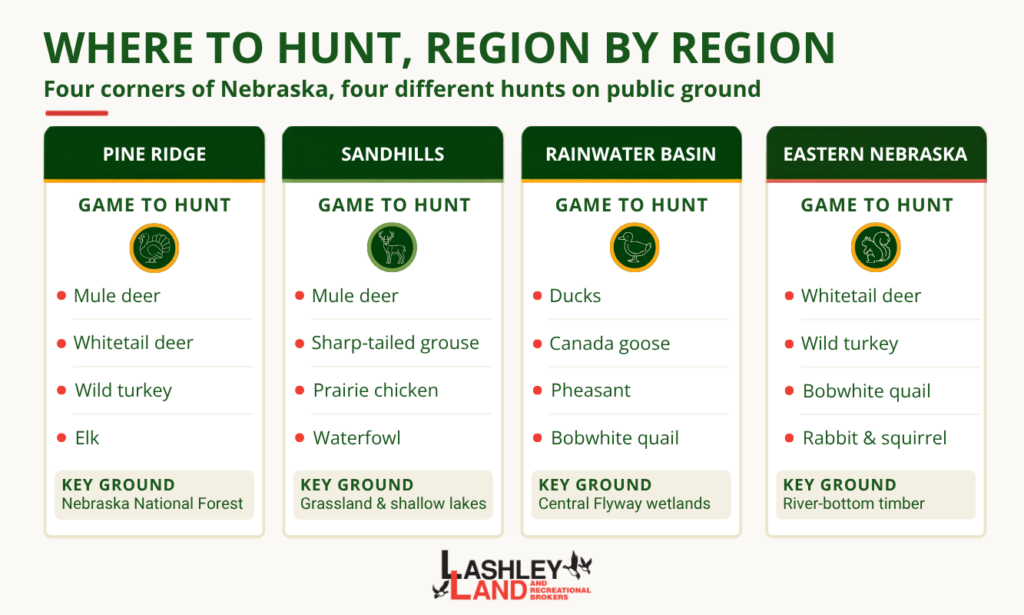
Where to Hunt by Region
Public land in Nebraska is spread across regions that each favor different game. Matching the region to your target is the difference between a long drive and a full game bag.
- Pine Ridge (northwest): Ponderosa pine ridges and canyons hold mule deer, whitetail, turkey, and elk. The Pine Ridge area has good federal and state ground, including Nebraska National Forest land.
- Sandhills (central and north-central): The largest dune system in the Western Hemisphere, with mule deer, prairie grouse, and waterfowl on the shallow lakes scattered through the grass.
- Rainwater Basin and Platte River (south-central): Prime waterfowl country on the Central Flyway, plus pheasant and quail on the surrounding grassland and crop edges.
- Eastern Nebraska and the Missouri River: River-bottom whitetail, turkey, quail, and small game in the timber and farmland along the state’s eastern border.
For the best odds, hunt the early morning and late evening when game moves most. During the migration and hard cold snaps, midday can also pay off. Learning a property before opening day, through the Atlas and a scouting trip, does more for a hunt than any piece of gear.
Owning Your Own Piece of Nebraska Hunting Ground
Public land opens the door, but a lot of hunters reach a point where they want ground of their own. Private hunting land gives you the same access year after year, the freedom to manage habitat on your own terms, and an asset that tends to hold value in strong wildlife country. The region you buy in shapes the hunt you get:
- The Sandhills combine bird populations and grazing value in large, multi-use tracts.
- The Pine Ridge offers scenic, broken country for deer and elk.
- The Missouri River corridor brings whitetail, turkey, and migratory bird hunting to the eastern side of the state.
Many recreational and hunting properties come with food plots, blinds, and established cover already in place, and Lashley Land offers recreational development services to build on what a property has. Our team at Lashley Land & Recreational Brokers brings over 140 years of combined experience across every hunting region in Nebraska. Ready to trade the crowded public draws for land of your own? Contact Lashley Land to talk with a Nebraska land specialist about hunting tracts that fit where and how you like to hunt.