
Why Harvest Matters to an Absentee Landowner (Even If You Never Set Foot in the Field)
The short answer
Harvest is the one time each year when your land shows you, in hard numbers, what it actually did. Yields, field condition, and your tenant’s performance all become visible and give you the data to make decisions for the coming year. Decisions such as rent, lease terms, fertility, and crop planning are far better when you have all the information from your land. You don’t need to be in the field. You just need to know what to ask for and what the answers mean.
Why this matters to you
When you own land from a distance, it’s easy to let the farming year become a repeating cycle: rent comes in, taxes go out, and the farm performs however it performs, by luck. It doesn’t have to be that way. Farmland is an asset that is either performing well or underperforming, and most of what you need to know to move from luck to an informed, strategic direction is revealed at harvest.
Harvest is when the crop comes off every acre, when equipment crosses every field, and when yield numbers turn a year of guesswork into facts. If you skip it, you’re making next year’s decisions with less information than you could have and putting your investment at risk.
Understand: What harvest tells you
How the land performed. Yield (bushels per acre) is the simplest measure of how a field performed with the crop that was planted. A number alone doesn’t tell you much, so compare it with other yields in the county. One year proves little, because weather can swing any field, but a pattern of lagging behind or outperforming your neighbors over several years is worth a real conversation about soil fertility, crop rotation, or management.
How much came to you. There are many ways to set up lease terms, but every lease comes down to one question: how much of the field’s production comes back to you? That might look like cash rent, fixed bushels, shares, or a flex of the above. As the landowner, you deserve an equitable share of what comes off the field.
What shape the ground is in. Harvest puts heavy equipment on every acre, and that is when damage happens: ruts and compaction from harvesting wet ground, erosion, fences, and field entrances. Problems are much easier to document and resolve right after harvest than six months later.
How the relationship is working. Did your tenant communicate during the season? Did harvest go smoothly? How a tenant handles a hard year, or a good one, tells you a lot about whether the partnership is healthy.
Whether something went wrong. Hail, drought, flooding, and other losses are documented at harvest. If you share in the crop or have an interest in crop insurance, claims come with deadlines, so ask early and ask directly.
Decide: What harvest sets up
Next year’s rent. Harvest results and current prices show how much room the operation has. Once you have the yield results and know how you compare with your neighbors, the next question is what comes next. The best rent isn’t the highest number you can negotiate. It’s the one both sides can live with over several years, built on a growing understanding. That might mean a betterment plan for the farm, a plan to raise the yield coming back to you, capital improvements, or specialty crop options for extra income.
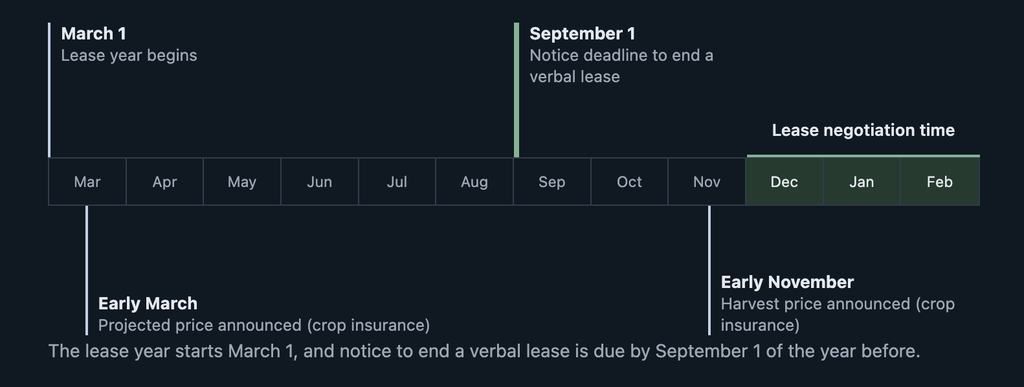
Lease timing. Deadlines for ending or changing a lease are important to understand. In Nebraska, notice to end an oral farm lease is generally due by September 1 for the lease year that begins the following March 1, and a missed date can lock you into another year. If you missed it this year, put September 1 on your calendar now for next year. We highly recommend, and exclusively practice, written lease agreements so that owner and tenant both understand their roles and responsibilities, and so termination terms are spelled out instead of left to default rules.
Fall field work and fertility. Soil testing, cover crops, drainage or terrace repairs, next year’s crops, and brush or weed control often get decided in the fall. Your lease determines who pays for what, and it’s much better to settle that before the work than after.
Whether to keep your operator. Harvest replaces gut feeling with evidence. A good tenant with strong results and good understanding is worth keeping and recognizing. A pattern of weak results, poor field condition, or poor communication is worth addressing before the next season starts. Numbers don’t tell everything, and the owner-tenant relationship can make or break your bottom line more than a dollar-per-acre rent difference ever will.
Perform: How to stay informed from a distance
You can do all of this without driving to the farm.
- Call your tenant or manager during harvest. Ask three things: How is it going? What are yields looking like? Is there anything I should know about the ground?
- Ask for final yield information when harvest wraps up, ideally by field, along with any comments worth noting.
- Have the farm looked at after harvest, whether by you, your manager, or a trusted local contact, and ask for photos of the equipment, the land, and anything unusual.
- Keep a one-page record for each farm: yield, county comparison, rent, field condition notes, and lease dates. After three or four years it becomes one of your most valuable decision tools.
- Start talking with your tenant about next year when harvest wraps up, and aim to settle terms by the end of the December to February negotiation window, not after the rent is already due. Cover any change in tenants, lease terms, lease style, or equipment, and anything else either of you needs to know.
- Calendar your key dates before the season ends and plan checkpoints around them (crop insurance dates shift each year, so confirm them with your agent).
What I’d do
If I owned land from a distance, I’d do three things every harvest: check in with the operator during the season, get yield results for each field, and have someone look at the ground afterward. I’d keep it conversational rather than adversarial. My approach is to trust the operator and verify the performance, and most good tenants appreciate a landowner who pays attention. Questions shouldn’t threaten a good operator. If you haven’t already, I’d also move to a written, signed lease. Handshake leases built a lot of good relationships, but a written lease protects both of you if something changes. It spells out roles and responsibilities, sets the termination terms, and gives the owner concrete evidence and security if anything ever goes off the agreement.
I’d change that approach if the tenant is slow to share basic information, if field conditions are getting worse year over year (a pattern over time, not one bad year), or if yields keep trailing similar ground nearby. Those are signs it’s time for a closer look rather than a friendly call.
Not sure how your farm did this year?
If you own farmland and aren’t sure how this year’s harvest compares with your neighbors’ or your own past years, I’m happy to walk through it. Send me your lease and whatever you’ve heard from your tenant, and I’ll tell you where you stand and what I’d do next. My contact information is just below.
For the Landowner. With the Operator. For the Land. Professional Management & Strategic Advisory for Agricultural Landowners
Lashley Land Farm & Ranch Management, powered by Tom Moss. This article is general information for agricultural landowners and is not legal, tax, or insurance advice. Lease and notice rules vary by state and by the terms of your agreement, so consult your attorney or advisor for your situation.