
Short Answer: Market timing and commodity prices come and go. How you manage your ground will compound over decades.
The day-to-day business decisions a farm operator makes about soil, water, infrastructure, leases, and recordkeeping shape what the property is worth at sale, refinance, or inheritance, often more than any single market cycle. Two neighboring farms in the same Nebraska county can carry very different values based purely on how each one has been managed over the past 20 years.
For current farm owners, your business decisions directly control your long-term land value. You cannot control prices, interest rates, or buyer demand. You can control how the ground gets farmed, how the water gets used, how the equipment gets maintained, and how the records get kept. Each of those decisions either adds to or subtracts from your land’s long-term value. The good news is that most of the highest-value management practices are also good for the land itself.
What “Farm Management” Actually Covers
Farm management is a broader term than most landowners realize. A complete farm management approach covers every decision that affects how productive, valuable, and saleable your land is over time. Whole farm planning generally includes:
- Lease structure and tenant relationships that affect both annual income and long-term soil condition
- Soil health practices like crop rotation, cover crops, no-till, and nutrient management
- Water and irrigation upkeep including wells, pivot maintenance, and water rights documentation
- Infrastructure and equipment including buildings, fences, drainage tile, grain storage, and access roads
- Conservation program participation including CRP, EQIP, and CSP
- Farm financial management covering record keeping, crop insurance, and tax planning
A Background in Nebraska Land Value
Nebraska’s farmland market is in a recalibration period. The University of Nebraska-Lincoln’s 2026 Farm Real Estate Market Survey put the statewide average at $3,905 per acre, the second straight year of modest decline after the 2024 record.
The bigger story is how widely values vary across the state. The East district averages $9,315 per acre. The Northwest district averages $970 per acre. The same management decisions can carry very different dollar weight depending on where the ground sits.
Land class matters as much as region. USDA data shows Nebraska irrigated cropland at $8,850 per acre versus dryland at $5,600, a $3,250 per acre premium for water access. Grazing land values for livestock operations rose 4 to 7 percent in 2026 on the back of strong cattle prices, while cropland softened.
Why This Matters: Soft agriculture economics reward well-managed land. When values flatten, buyers get pickier, appraisers scrutinize more, and the gap between a well-kept farm and a neglected one widens.
The Top Drivers of Long-Term Land Value
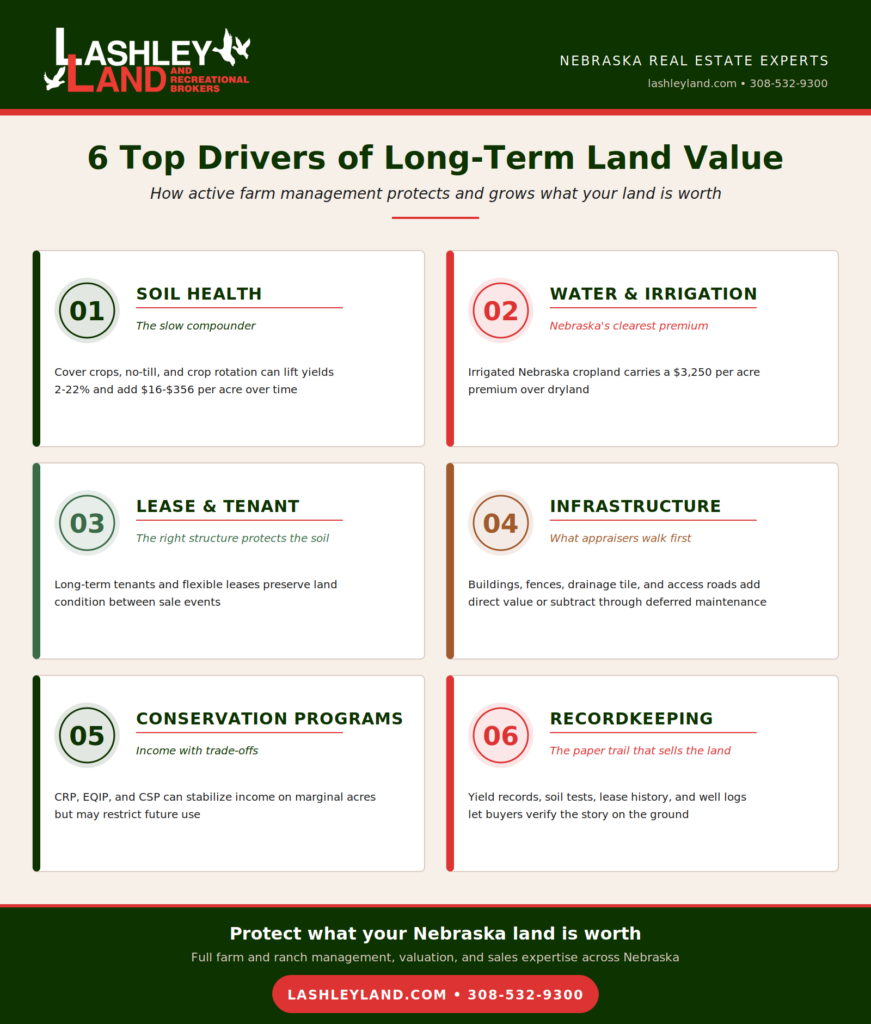
1. Soil Health and Long-Term Productivity
Soil health is the longest-running compounding effect in farmland value. The practices that build it are familiar in production agriculture: crop rotation, cover crops, no-till or reduced-till, and nutrient management. The economics increasingly support adoption. American Farmland Trust case studies of row crop farming operations found yield increases ranging from 2 to 22 percent after adopting soil health practices, with the value of those gains running from $16 to $356 per acre. A separate USDA and SARE study showed most farmers turning a profit on cover crops within two to three years.
For long-term land value, the real benefit is what shows up on a productivity rating. Soil organic matter, water-holding capacity, and erosion resistance all affect NRCS soil maps and Crop Productivity Index ratings. Those ratings are what appraisers and farmer-buyers look at. Ground that has been managed for soil health over a decade carries a productivity story that newer practices cannot match.
2. Water Access and Irrigation Infrastructure
Water is one of the clearest premiums in Nebraska land value. The $3,250 per acre gap between irrigated and dryland cropland reflects what buyers will pay for reliable water access and the natural resources beneath the ground. That premium gets larger when the irrigation system is well maintained and the water rights are clearly documented.
Active water management includes:
- Well registrations and documented pumping capacity
- NRD allocations in good standing and accurately recorded
- Pivot maintenance including end-gun function, drive train condition, and recent service records
- Water rights documentation organized and ready for buyer due diligence
Nebraska also benefits from the Ogallala Aquifer, which has drawn out-of-state buyers from Oklahoma, Texas, and other states where groundwater is becoming scarce. That outside demand puts a premium on Nebraska ground with secure water access. An irrigated farm with an aging pivot, unclear allocations, or deferred well maintenance loses much of its water premium at sale.
3. Lease Structure and Tenant Relationships
The lease is one of the most underrated tools in long-term land value. A cash rent lease gives the landowner predictable income but transfers all soil management decisions to the tenant.
A crop share lease aligns landowner and tenant interests but ties income to commodity prices. A flexible lease combines elements of both and can include conservation incentives or input cost adjustments. With cash rents declining 1 to 9 percent across Nebraska in 2026, more farm owners are revisiting their lease structures to match current personal goals and market conditions.
The tenant is the other half of the equation. A long-term tenant who treats the ground like their own ends up adding value year after year through good rotations, careful input management, and timely repairs. A short-term tenant focused only on maximum yield in a single season can pull value out of the soil in ways that take years to recover.
4. Infrastructure and Capital Improvements
Infrastructure shows up directly at appraisal. Grain storage, well-maintained fences, working drainage tile, sound buildings, and reliable access roads all add measurable value. Equipment that comes with the property, when applicable, adds to that picture.
Deferred maintenance is the silent value killer. A fence line that needs replacement, a barn with a failing roof, or drainage tile that has not been inspected in 20 years all show up as deductions when a buyer or appraiser walks the property. Weather conditions accelerate the damage. A few hard winters or wet springs can turn a small repair into a major project.
Routine upkeep is far less expensive than restoration at sale. Active farm business management treats infrastructure on a maintenance schedule, not as a reaction to failures. The cost of a roof inspection or a fence repair is small compared to the appraisal hit from neglect.
5. Conservation Program Participation
Conservation programs are an income lever that also affects land value. The Conservation Reserve Program (CRP), Environmental Quality Incentives Program (EQIP), and Conservation Stewardship Program (CSP) all offer income streams and stewardship benefits in exchange for specific land use commitments.
These programs can stabilize income on marginal acres, improve soil and water outcomes, and add to the land’s stewardship story. They can also restrict future use and affect resale flexibility. CRP-enrolled ground, for example, cannot be brought back into production until the contract ends without penalty.
The right decision depends on the parcel, the owner’s long-term goals, and the buyer pool the land would eventually attract. Cattle ground in the Sandhills, dryland in the Panhandle, and prime cropland in the east each respond differently to enrollment.
A program that adds value on one property can drag value on another. The choice belongs in the strategic plan, not in a reactive decision.
6. Recordkeeping and Documentation
Documentation does not change the physical land, but it changes what a buyer is willing to pay for it. Good record keeping includes:
- Yield records and field maps by parcel, ideally going back several years
- Soil test results showing current fertility and trends
- Input application records for fertilizer, herbicides, and seed
- Lease history with terms and tenant continuity
- Well logs, pivot service records, and water rights paperwork
- Conservation program enrollment and compliance status
- Crop insurance history and any documented loss events
A property that comes with organized records sells faster and closer to asking price because the buyer can verify the story on the ground. Active landowners build this paper trail year after year. Passive owners scramble to assemble it at sale, and the gaps usually cost them money.
The Farmer-Buyer Effect
According to Hertz Farm Management, farmers buy roughly seven out of ten farms that sell. That single fact shapes how well-managed land sells. From beginning farmers to established operators, farmer-buyers walk a property with a trained eye. They check soil color, residue cover, fence condition, well logs, and access roads. They ask about yield history, fertility programs, and lease terms.
This is why all six drivers above matter together. Individuals buying farmland for production agriculture are evaluating the whole picture, not just acreage and location. Soil that has been managed well, water that is reliably documented, infrastructure that has been maintained, and records that tell a clear story all add up to a property that commands its asking price. The opposite is also true. Missing pieces in any one area give the buyer leverage to negotiate down.
Talk to Lashley Land About Your Long-Term Value

Farm management is the most controllable lever in long-term land value. The decisions you make this year about soil, water, leases, infrastructure, and records add up over decades into either a well-positioned property or a discount at sale. Profitability, resale value, and farm business decisions all benefit from active management instead of passive ownership.
At Lashley Land & Recreational Brokers, our team offers full farm and ranch management services along with valuation, sales, and consulting expertise across every region of Nebraska. With 140+ years of combined experience, our farm managers work with landowners to protect and grow long-term value, prepare properties for sale, and guide families through transitions.
Contact Lashley Land today for an honest conversation about your land, your management decisions, and what your property is worth in today’s market.