
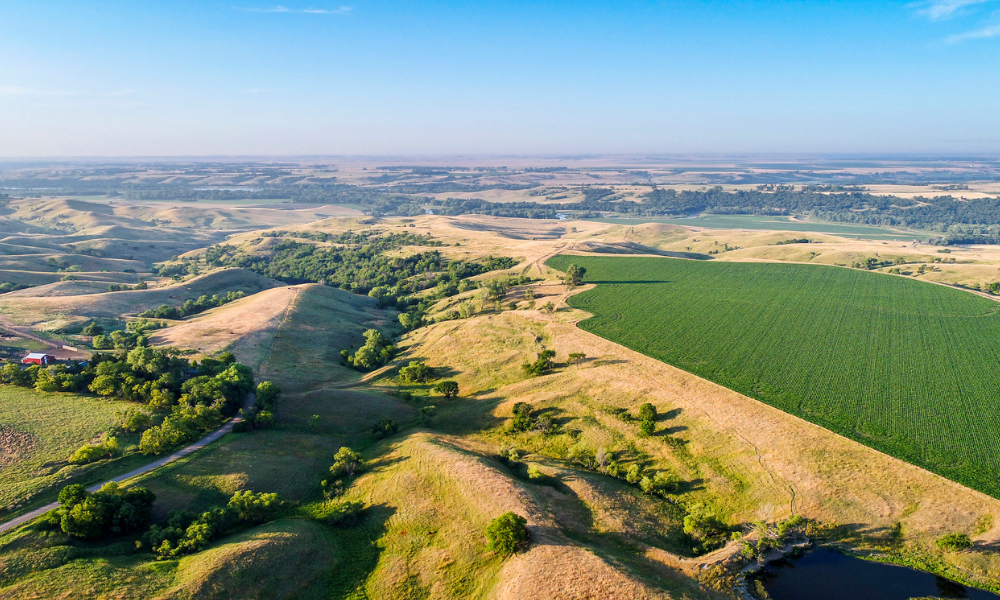
At a Glance: Nebraska farmland value per acre is best evaluated by starting with the statewide benchmark of $3,905 per acre (per the University of Nebraska-Lincoln’s 2026 Farm Real Estate Market Survey), then adjusting for land class, region, water access, soil productivity, cash rent income, and current commodity prices. The most accurate evaluations layer the UNL survey, USDA-NASS county data, recent comparable farmland sales, and input from a qualified rural appraiser or local land broker.
Nebraska farmland has always been one of the most reliable assets a family can own, but knowing what an acre is actually worth takes more than checking a state average. With values shifting two years in a row and commodity markets putting downward pressure on cropland, buyers, sellers, and heirs need a clear framework for evaluation.
Start With the Statewide and Regional Benchmarks
What Is the Average Farmland Value in Nebraska Right Now?
Nebraska’s average all-land value sits at $3,905 per acre as of February 1, 2026, a 1% decline from the 2025 average of $3,935 and the second consecutive annual drop following the 2024 record of $4,015 per acre. That data comes from the UNL Center for Agricultural Profitability’s 2026 Nebraska Farm Real Estate Market Survey, which polls appraisers, farm and ranch managers, and agricultural bankers across the state each year.
Survey respondents pointed to lower crop prices, elevated farm input costs, and prevailing interest rates as the primary forces tightening operator finances and weighing on land values.
A few other useful benchmarks, and what they actually tell you:
- USDA-NASS reported Nebraska cropland averaged $6,540 per acre in 2024, up 6.3%. Cropland values run well above the all-land average because tillable acres generate higher and more predictable income than pasture or rangeland. If your property is mostly tillable, the all-land number undersells it.
- Pasture averaged $1,400 per acre in 2024, up 7.7%. That gain matters because it tells you the cattle market is pulling grazing land up while cropland softens. The two are no longer moving together.
The takeaway: don’t anchor to one figure. Use the UNL average to set the trend, then jump to the benchmark that matches what you actually own.
How Values Vary Across Nebraska’s Eight Districts
The statewide average flattens out enormous regional differences, and those differences are not random. They follow rainfall, soil quality, and proximity to grain markets.
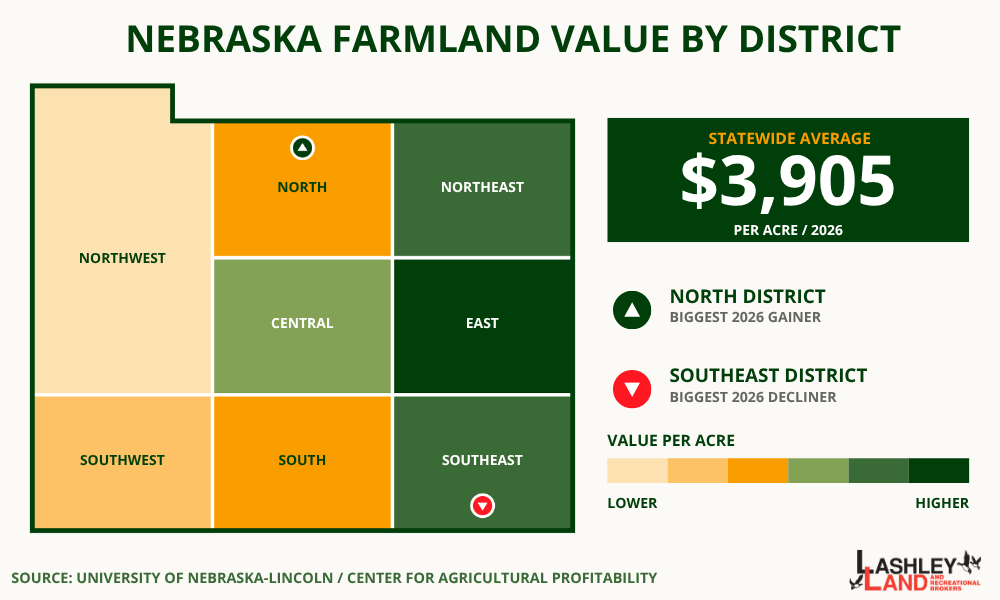
- Eastern Nebraska commands the highest values in the state, anchored by deep loess soils, reliable rainfall, and short hauls to ethanol plants and Missouri River terminals. Higher yields support higher cash rents, which support higher land values.
- Northwest and Sandhills country sits at the opposite end. Lower rainfall, sandy soils, and longer distances to market mean fewer income streams per acre, even when the ground itself is highly productive for cattle.
- The North District posted the strongest gains in 2026, driven by cattle market strength and competition for grazing acres.
- The Southeast District saw the largest decline, weighed down by heavy exposure to softer corn and soybean prices on irrigated row crop ground.
If your property sits in the East, the $3,905 statewide average will badly underestimate it. The opposite is true in the Northwest. Always anchor to your district before you compare.
Identify the Land Class
Land class is the single biggest driver of per-acre value in Nebraska, and right now the five major classes are moving in different directions because the crop and livestock economies are telling different stories.
The Five Major Nebraska Land Classes (2026 UNL Survey)
- Center pivot irrigated cropland (down 2% statewide, with some districts losing 4% to 8%): Still the most valuable class, but also the most exposed to corn and soybean prices and pumping costs. When commodities fall and energy stays expensive, irrigated returns compress fast.
- Gravity irrigated cropland (down 3% statewide): Same pressure as pivot ground, plus higher labor demand and lower water-use efficiency. Buyers are discounting it more aggressively.
- Dryland cropland with no irrigation potential (down 1% statewide, 3% to 5% in some districts): Less exposure to pumping and well maintenance softened the decline, but lower grain prices still pulled values down.
- Dryland cropland with irrigation potential (down 2% statewide, 3% to 6% in some districts): Buyers pay a premium for the option to add a pivot someday, but with high interest rates making development expensive, that option is worth less than it was two years ago.
- Grazing land and hayland (up 4% to 7%, nontillable grazing leading at +7%): This is the cattle market story. Tight national herd numbers and strong calf prices have cow-calf producers bidding aggressively for additional acres.
Why Cattle Country Is Bucking the Trend
Cropland is softening, but pasture and grazing land are appreciating. Nebraska crop receipts fell roughly 16% in 2025, partially offset by a sharp increase in livestock receipts statewide. Cash rental rates tell the same story: cropland rents slipped 1% to 9% depending on land type and region, while pasture and cow-calf pair rents rose about 4% to 5%. If you own pasture, the wind is at your back.
Use Cash Rent as a Real-World Value Indicator
Cash rent is one of the most reliable signals of what farmland is actually worth, because it reflects what an operator will pay based on expected yields, commodity prices, and profit margins.
How Cash Rent Reflects Farmland Value
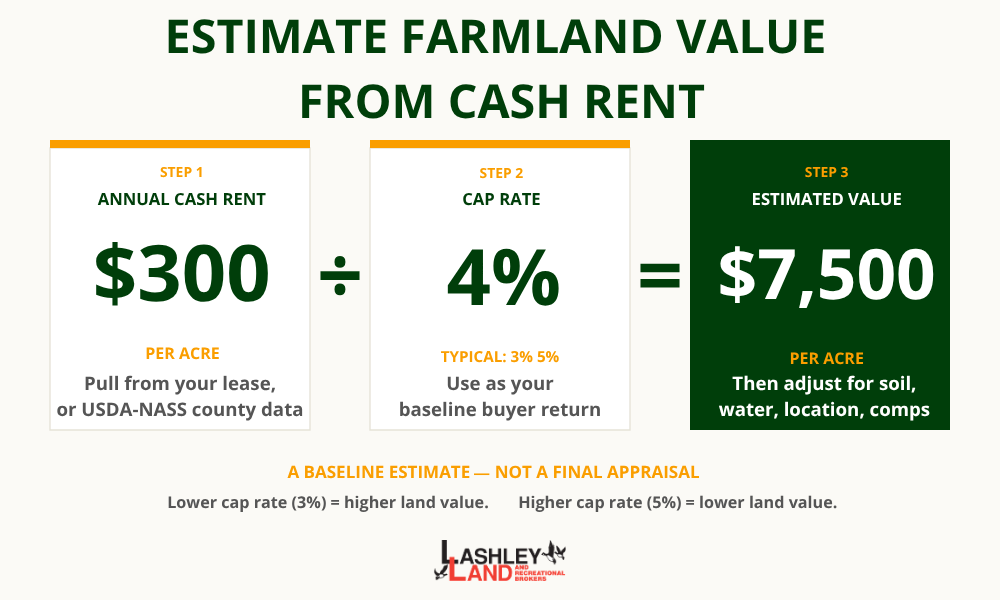
A simple shortcut: divide annual cash rent by a typical Nebraska capitalization rate of 3% to 5% to get a baseline value estimate. If a parcel rents for $300 per acre at a 4% cap rate, that suggests a value near $7,500 per acre before adjustments.
Current trends:
- Cropland cash rents declined 1% to 7% in 2025 due to lower commodity prices and rising input costs
- Pasture and cow-calf pair rents rose 3% to 4%, mirroring cattle market strength
2025 Nebraska Cash Rent Highs and Lows
USDA-NASS county estimates show how wide the spread really is:
- Highest irrigated rent: Cedar County at $355 per acre
- Highest dryland rent: Dakota County at $293 per acre (statewide average $266.50)
- Highest pasture rent: Wayne County at $90.50 per acre
- Lowest dryland rent: Kimball County at $28 per acre
- Lowest pasture rent: Scotts Bluff County at $11 per acre
Factor in the Property-Specific Value Drivers
Two parcels in the same county can vary by thousands of dollars per acre based on the details. Before comparing your property to any regional average, walk through the specifics.
What Adjusts a Per-Acre Price Up or Down
- Water availability and irrigation rights: registered wells, NRD allocations, pivot infrastructure
- Soil productivity: NRCS soil maps, Crop Productivity Index ratings, drainage class
- Location and access: proximity to grain elevators, ethanol plants, and paved roads
- Parcel size and shape: larger contiguous tracts typically command a premium per acre over small, irregular parcels
- Improvements: grain bins, fencing, livestock water, hunting blinds, rural homes
The Macro Forces Putting Downward Pressure on Values
Even great parcels are evaluated against a national backdrop. Right now that backdrop includes:
- Lower corn and soybean prices through 2025
- Elevated farm input costs for fertilizer, seed, and fuel
- Higher interest rates raising the cost of land loans
- A meaningful drop in Nebraska net farm income in 2024
Lower commodity prices, tighter profit margins, and higher interest rates are the three forces survey respondents and ag loan officers cite most often when explaining the modest declines of the past two years.
Use the Right Tools and the Right People
Per-acre value is part data, part judgment. Both matter.
Trusted Data Sources for Nebraska Farmland Valuation
Layer multiple sources rather than trusting any single index. The Purdue Farmland Value Survey is widely cited nationally, but it focuses on the broader Corn Belt and does not capture Nebraska’s range of land classes or its eight ag statistic districts. For Nebraska specifically, rely on:
- UNL Center for Agricultural Profitability: annual statewide and regional land values
- USDA-NASS: county-level cropland, pasture, and cash rent estimates
- FCSAmerica benchmark farms: four-state trend data covering Nebraska, Iowa, South Dakota, and Wyoming
- Local sale comps: recent farmland sales within the same county and land class
When to Bring in a Rural Appraiser or Land Broker
Data gets you close. People who walk Nebraska ground every week get you to the right number. Bring in an appraiser or local broker when you are dealing with:
- Estate settlements and inherited farmland
- Sales involving multiple heirs or partners
- Transactions over 80 acres or mixed land classes
- Properties with water rights, mineral interests, or recreational value
The Bottom Line on Nebraska Farmland Value Per Acre
Evaluating Nebraska farmland value per acre is a layered process, not a lookup. Here is the framework in one place:
- Start with the $3,905 per acre statewide average, then adjust by land class and region
- Cross-check using county-level cash rent data and recent local farmland sales
- Account for current downward pressure from commodity prices, input costs, and interest rates
- Recognize that grazing land and pasture remain the bright spots in 2025 and 2026
- Bring in a trusted appraiser or broker before you sign anything
Whether you are buying your first quarter section, selling family ground, or settling an estate, the right per-acre price comes from people who know Nebraska land district by district. Contact Lashley Land to get a grounded, honest valuation backed by more than 140 years of combined experience across Nebraska’s farms, ranches, and recreational properties.