
Is Buying Land a Good Investment? Nebraska Land Market Insights for 2026
The Short Answer: Yes, buying land can be a smart investment for buyers who plan ahead. As a long-term investment, land carries a limited supply, its value tends to climb over time, and it acts as a reliable hedge against inflation. Returns depend on thorough research, realistic timelines, and a clear understanding of both the rewards and the additional costs involved.
Raw land has become one of the most talked-about real estate investments of the decade, and for good reason. It doesn’t depreciate the way buildings do, it gives owners full control over the property, and it holds value when markets turn volatile. Agricultural land, undeveloped land, and recreational property each behave differently as investments, yet the principles behind a successful land purchase stay the same whichever type you choose.
Why Land Holds Its Value in 2026
Land Is a Finite Resource
Scarcity is the strongest argument for land investment. No one is producing more of it, and steady population growth paired with expanding cities pushes demand against a fixed supply. That imbalance tends to lift property values over time, which rewards land ownership held for the long term.
Current Market Trends Favor Buyers
Several trends are strengthening the case for land right now. The biggest is the race for AI and data center sites, which is driving fresh demand for rural parcels near power and energy infrastructure and lifting values in once-overlooked areas. Limited inventory of quality rural land continues to support prices across the Midwest, and buyers priced out of coastal markets keep looking inland for space and value. Nebraska benefits directly from each of these shifts because quality ground here still trades well below coastal markets. You can browse current Nebraska land listings to see how local pricing compares.
Types of Land Investment in Nebraska
Agricultural Farmland
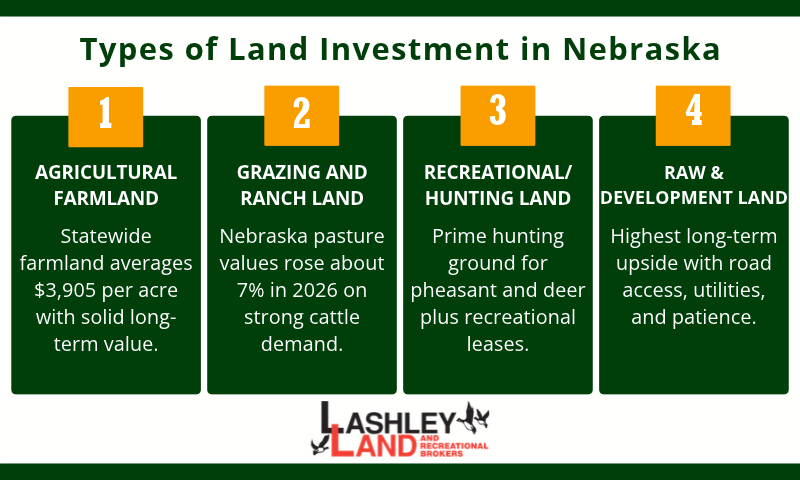
Agricultural land remains the anchor of land investment in Nebraska. The statewide average sits at $3,905 per acre as of early 2026, a slight decline driven by lower crop prices and higher interest rates, yet the long-term fundamentals stay strong. Productive ground still earns rental income and holds value through full market cycles. Our team can help you evaluate Nebraska farms for sale based on soil quality and irrigation access.
Grazing and Ranch Land
Grazing land is moving in the opposite direction. Pasture values climbed roughly 7% in 2026 on the back of a strong cattle market, outpacing cropland. Ranch buyers benefit from Nebraska’s fertile soils and access to the Ogallala Aquifer. Explore available Nebraska ranches for sale, or add a farm and ranch management partner to keep an operation productive.
Recreational and Hunting Land
Recreational property draws buyers who want outdoor activities and weekend access alongside long-term appreciation. Nebraska offers some of the most varied hunting in the country, including pheasant, quail, mule deer, and white-tailed deer. These parcels suit weekend retreats, hunting leases, and other recreational activities on land you own. Browse recreational and hunting land to see what is currently available across the state.
Raw and Development Land
Raw land near growing communities carries the highest upside and demands the most patience. The best candidates have road access, nearby utilities, proper zoning for their intended use, and no flood-zone complications. A persistent national housing shortage of more than four million homes keeps pressure on well-located development ground. These properties rarely produce immediate income while you wait, yet vacant land can deliver substantial returns once future development reaches the area.
The Benefits of Owning Land
A Tangible Asset You Control
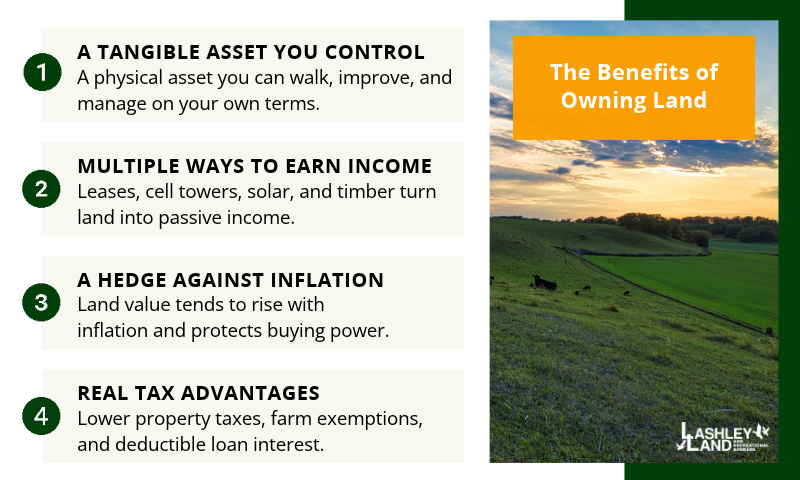
Land gives you a physical, long-term asset you can walk, improve, and manage directly. Unlike stocks, its value does not vanish in a market panic, and you can raise the land’s value through fencing, access roads, water development, and habitat work. That control brings a steadiness that paper investments cannot match.
Multiple Ways to Earn Income
Well-chosen land can produce passive income and cash flow while it appreciates. Common options include:
- Leasing cropland or pasture to local farmers and ranchers turns a parcel into a rental property with steady annual rent.
- Hunting and recreational leases turn idle acreage into seasonal income.
- Cell towers, solar arrays, and wind agreements pay long-term lease revenue.
- Timber harvests provide periodic returns on forested tracts.
A Hedge Against Inflation
Land is a dependable hedge against inflation because its value tends to climb as the cost of goods rises. When the dollar buys less, real assets like land and the structures on them generally hold or gain worth, which protects your purchasing power over the long term.
Real Tax Advantages
Ownership opens several tax benefits that improve your net return. Undeveloped parcels usually carry lower property taxes than improved real estate, and qualifying agricultural land may receive valuable exemptions. Property tax and loan interest can often be deducted as well. Review the tax benefits of owning land before you buy.
Challenges to Weigh Before You Buy
Financing and Higher Interest Rates
Land costs more to finance than a home does. Lenders typically ask for down payments of 20% to 50% on raw land, charge higher interest rates, and set shorter repayment terms than a residential mortgage. Closing fees, surveys, and environmental assessments add to the additional costs. Some owners offer seller financing, which can ease the upfront burden for a qualified buyer. Knowing your financing options up front tells you what you can afford before you start making offers.
Carrying Costs and Patience
Land builds wealth slowly rather than paying you right away. You will cover annual property tax, maintenance on access roads and fencing, and occasional insurance while the value appreciates. Most gains arrive over years as surrounding areas grow, which rewards buyers who think in decades instead of months.
Due Diligence
Careful research protects your investment and supports an informed decision. Confirm zoning and future development plans, verify water rights and mineral rights, check for flood zones, conservation easements, and environmental concerns, and make sure the property has legal road access and utility availability. Skipping these steps is the fastest way to turn a promising parcel into a costly mistake.
Why Nebraska Rewards Land Buyers
A Strong Agricultural Base
Nebraska’s fertile soils, Ogallala Aquifer irrigation, and reliable growing climate keep it among the nation’s top agricultural producers. That productivity supports land values through working farm and ranch use, which gives buyers a practical floor under their investment.
Reasonable Prices and Room to Grow
Compared with coastal states, Nebraska offers affordable entry points and quality ground priced for appreciation. Demand from both agricultural and recreational buyers continues to climb, which leaves room for values to rise as the state grows.
A Central, Connected Location
Nebraska’s strategic location in the heart of the country provides strong access to national markets and transportation routes. That connectivity benefits working operations today and supports future development potential down the road.
Is Land the Right Investment for You?
Buying land is a strong move for buyers with discretionary capital, patience for long-term appreciation, and room in the budget for property taxes and upkeep. Even a first-time buyer can do well with land investing by starting with a straightforward parcel and holding it long enough for the area to grow. It rewards research and realistic expectations far more than it rewards quick wins. Nebraska makes the case especially well, pairing productive agricultural land with reasonable prices and a strategic location.
Lashley Land helps buyers and sellers move with confidence across farms, ranches, recreational property, and rural homes. Every transaction is backed by more than 140 years of combined experience in Nebraska real estate. To weigh your goals and find the right parcel, contact our team or call 308-532-9300 to schedule a free property consultation. You can also start by exploring the fundamentals of investing in land.